


When did podcasts start?
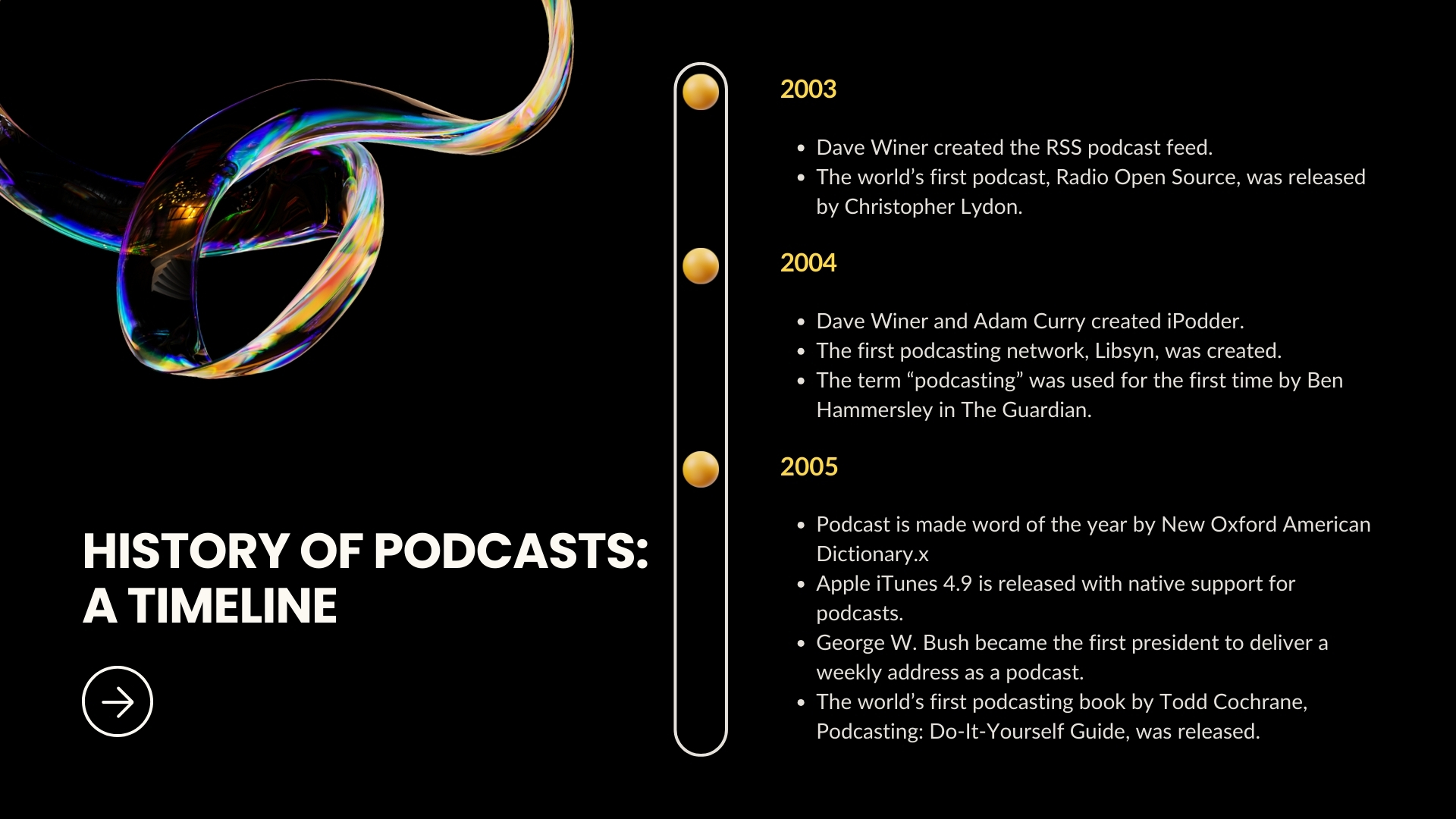
Before podcasts emerged in the early 21st century, people experimented with video blogs and internet radio. In 2003, software engineer Dave Winer created an audio RSS feed for Christopher Lydon, who used it to share notable interview recordings on his blog.
Recordings of Lydon’s interviews were shared at BloggerCon in 2003. The next year, Dave Winer and Adam Curry developed iPodder, allowing users to download audio content to their iPods. These broadcasts, soon called podcasts, were inspired by the iPod.
By late 2004, the first podcast hosting platform, Libsyn, was launched. In 2005, Steve Jobs integrated podcast subscriptions into iTunes, propelling podcasts from a niche hobby to the mainstream.
When did podcasts become popular?
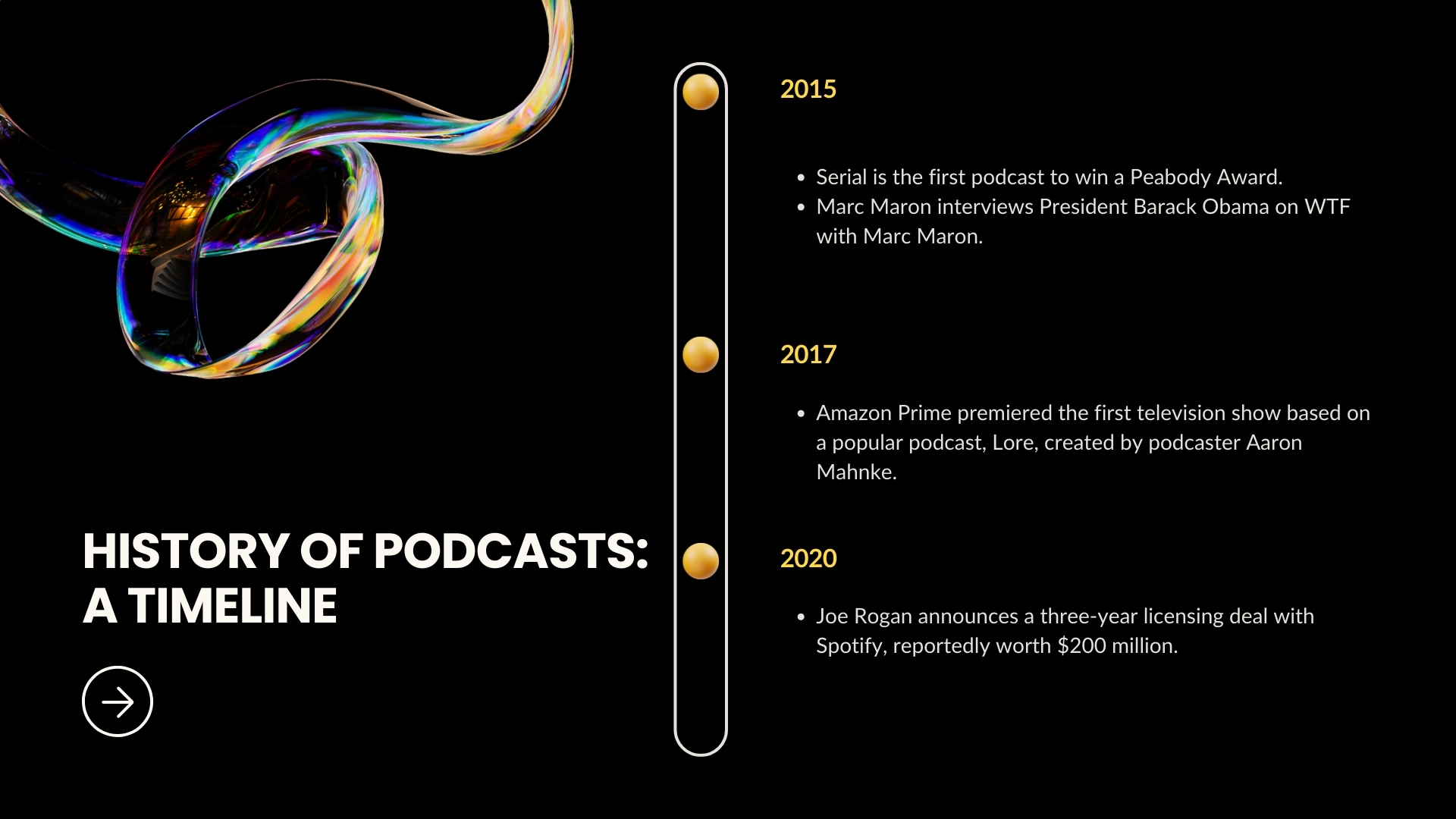
Podcasts gained steady popularity since 2004, but the true crime podcast “Serial” marked their breakthrough, becoming the first to reach five million unique downloads on iTunes. Monthly podcast listeners in America grew from 40 million in 2014 to 88 million by 2019.
What was the first podcast?
Technically, Christopher Lydon’s “Radio Open Source,” launched in 2003, was the first podcast, though the term “podcast” hadn’t been coined yet. The term was later coined by Guardian columnist Ben Hammersley and popularised by Adam Curry. After creating iPodder, Curry launched the first true podcast, “The Daily Source Code,” which featured insights on podcasting, his daily life, general news, and music from the Podsafe Music Network.
The rise of podcasts’ popularity:
Podcasts offer an incredible variety of shows on virtually every topic imaginable, catering to almost any niche passion or interest. For example, the comedy podcast “Denzel Washington Is The Greatest Actor Of All Time Period” reviews Denzel Washington’s filmography in alphabetical order, while “Shezam” is specifically for female magicians.
As podcasts have gained popularity, so have the advertising opportunities associated with them, particularly on social media.
Podcasting in recent years:
Podcast statistics show that the podcast advertising market worldwide is expected to reach US$4.02bn in 2024. These numbers show that podcasting has become an Industry that is very big.
Podcast history timeline:

Where will I be hosting the Podcast?
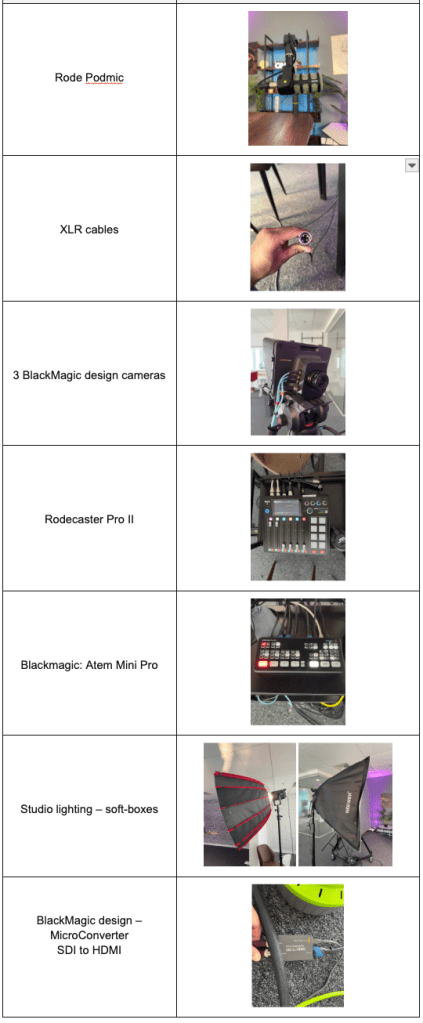
The most practical location for me to record my podcast is within the podcast suite at the Global Academy. By utilising the studio, not only is it cost free, but also contains all the necessary media standard equipment. The studio has versatile backdrops, high-quality Rode microphones, Black Magic Design cameras, advanced lighting panels, and a vision mixer for live editing during recording sessions. These tools enhance efficiency the overall production process.
Technical research
Software and hardware I’ll be using:
Software:
Adobe Photoshop – for colour grading social media posts.
Adobe Photoshop – for making thumbnails and social media posts.
Adobe Premier Pro – for editing the podcast visual footage
Adobe Audition – for editing podcast audio
Why I am using Adobe Premier Pro
Using Adobe Premiere Pro to edit my podcast is an ideal choice because it offers a professional and flexible set of tools that match all of my editing needs. First and foremost, I need to cut out specific clips or sections from the podcast—Premiere Pro makes this easy with its precise timeline editing and razor tool, allowing me to remove unwanted parts smoothly without affecting the overall flow.
I also want to include a custom watermark, specifically a ‘Bhujangi Podcast’ logo, to consistently brand my video. Premiere Pro also allows me to easily overlay images or graphics, adjust their size, position, opacity, and even animate them subtly to make the branding more uniformed
In addition, I’m hoping to add a custom intro and outro, which are essential in customising the podcast and establishing its name. For a more cinematic look, I can import my own motion graphics templates or use Premiere Pro’s built-in ones. I also use premier pro for multi-layer video and audio editing, where I can include images, music, and text in the opening and closing parts.
Why I am using Adobe audition:
Adobe Audition works extremely well in exporting high-quality audio from my podcast to platforms like Spotify and SoundCloud. It is specifically designed for advanced audio editing, mastering, and exporting, which goes hand in hand with the video editing I do in Premiere Pro.
Audition also works great with premier pro, as I can easily import my audio directly from a Premiere Pro project using the “Edit in Adobe Audition” feature. Audition therefore eliminates wasting time on manually exporting and re-importing files.
Once the audio is in Audition, I have the ability to edit the audio – Using, Adobe audition also allows me to adjust volume levels and EQ, to removing background noise, to enhance clarity, and add subtle effects like compression or reverb for a more polished sound.
I can export the final product as a high-quality WAV file, which is the preferred format for platforms like Spotify and SoundCloud, once done editing. Audition simply assures that the file is ready to be streamed.
In short, Adobe Audition allows me to:
- Quickly transfer audio from Premiere Pro
- Precisely edit and enhance podcast sound quality
- Export professional-grade audio in WAV format
- Streamline the entire post-production process
Why I will be using OpusClip.ai:
OpusClip.ai is a partform that allows you to generate clips. It is an extreme time saver, as I no longer have to spend hours searching for the right clip, captioning it, and designing it.
It basically picks out the highlights or key moments and turns them into engaging videos. All I would have to do is post it on the social media platforms such as Instagram. I have had many of these videos receive over tens of thousands of views.
Even better, each clip will come with a performance score out of 100, based on:
- Hook – how strong the beginning is
- Flow – how smoothly the content keeps viewers engaged
- Value – how insightful or entertaining the clip is
- Trend – how likely it is to go viral or align with current content trends
This means I’ll know right away which clips have the most potential, making it easy to prioritise what to post.
OpusClip will also generate subtitles automatically, which is a huge time-saver. Instead of writing and syncing them myself, I’ll just need to check for any small errors and customise the subtitle position and colour to match my branding.
Overall, using OpusClip.ai will streamline my entire editing process and let me focus more on creating and sharing great content, rather than spending hours in post-production.
Why I will be using Canva:
Canva is one tool that I can practically use for everything, including my project pitch. I’ll be using Canva to create my YouTube thumbnails, Instagram posters, and carousel posts. There are many times where I need a tool that is fast and efficient, where I can quickly create graphic work and have it seem professional.
Canva is extremely user friendly, which is one of the main reasons that I will use it. Whether I’m designing from scratch or using one of their templates, I can put together graphics in just a few minutes. It’s perfect for creating thumbnails that stand out, Instagram posters that pop, and carousel posts that are clean, engaging, and branded to match my podcast or content style, as I will be make a dedicated template.
Canva is also fully operational on the phone, which is extremely helpful as I can make quick edits on the go.
Overall, Canva will help me keep my content visually consistent and polished across platforms, while saving me a ton of time and letting me work flexibly from both my macbook and my iphone.
Why I Am Using Notion for Planning and Production
I have chosen to use notions as it is a perfect platform for planning out my work. Notions has helped me organise all my work and manage my deadlines.
Here’s how Notion supports my workflow:
Key Features That Make Notion Ideal:
1. Pages and Sub-Pages
- You can create unlimited pages for different tasks, projects, subjects, or categories.
- Each page can contain sub-pages, helping you organize everything hierarchically.
- Example: A main page for “Semester 1” can have sub-pages for “Courses”, “Assignments”, and “Deadlines”.
2. Databases and Tables
- Notion allows the creation of powerful databases, which can appear as:
- Tables
- Boards
- Calendars
- Lists
- Galleries
- Databases are interactive and support filtering, sorting, tagging, and linking, which makes it easier to manage large sets of information.
3. Calendars
- You can insert a calendar view to plan and track tasks, deadlines, and events.
- Events can be color-coded, tagged, and connected to other pages.
- You can also sync Google Calendar via third-party tools if needed.
4. Boards
- You can create drag-and-drop boards (great for production stages like “To Do”, “Doing”, “Done”).
- Helpful for visual learners and managing progress in multi-step processes.
5. Custom Templates
- Notion allows you to create custom templates for repeated workflows like:
- Weekly planners
- Daily production logs
- Content calendars
- Assignment trackers
6. Charts (via embeds or linked services)
- While Notion doesn’t support native charting yet, you can:
- Embed charts made in Google Sheets or Airtable.
- Use third-party integrations like NotionCharts to display live-updating bar, pie, or line graphs.
- Use formulas inside tables to do basic analytics or tracking (e.g. progress bars).
7. Tags and Linked Databases
- You can tag entries (like tasks or assignments) and link databases to each other.
- Example: A task in your content calendar can be linked to the corresponding class page or notes.
8. Checklists and To-Do Lists
- Easily create checklists, toggle lists, or bullet journals for daily planning.
- Tasks can be updated in real time and checked off as you go.
9. Mobile and Desktop Accessibility
- Notion is available on Windows, Mac, iOS, Android, and web.
- Changes sync across all devices instantly, allowing you to plan and track on-the-go.
- You can also work offline (limited functionality, auto-syncs once you’re online).
Notion replaces multiple tools like: Google Docs, Evernote, OneNote, and Excel. Allowing me to have one organised and visually structured platform. It helps not only to just plan my work, but actually do my work more efficiently.
Why I Am Using Riverside Studio:
Riverside is a platform that is especially helpful as it can also operate like zoom, where I have a meeting, yet it records it in high quality and edit it all in one place.
It will be extremely essential for my workflow as I plan to collaborate with an international guest who lives in Australia. Riverside provides the tools I need for seamless cross-time-zone, remote podcasting while maintaining professional production standards.
Summary of Key Benefits
| Feature | Benefit |
|---|---|
| 🌍 Remote Recording | Seamless collaboration with my guest in Australia |
| 🎥 4K Video + .WAV Audio | Studio-quality production, even remotely |
| ✂️ Built-in Editing | No need for extra software – faster workflow |
| 📝 Transcription | Easily skim/edit without re-watching full recording |
| 🎯 Highlights & Segments | Quickly identify moments for mid-form and short-form content |
| 📱 Cloud-Based | Accessible from anywhere – just a browser needed |
Studio Equipment:
Home Studio Equipment:

Equipment research
Most of my equipment is the same from last year. Only things new were the Home studio equipment set up, excluding the Iphone and Macbook.
I spent a lot of time doing research on what would be the ideal mic and also asked family friends and everything led up to the Blue Yeti Microphone.
Why I chose the Blue Yeti Microphone:
I chose to buy a Blue Yeti microphone for my at-home online podcasts because it offers high-quality audio while being incredibly user-friendly. One of the main reasons was its easy plug-and-play setup via USB, which makes it simple to connect directly to my MacBook using a USB-C adapter. There are also built in audio adjustment controls like gain, mute, and pattern selection. This is where I am able to review and edit the sound without the need of extra equipment. It also has a built in stand, not only providing comfort yet a practical and professional placement when filming, rather than just holding it in my hands. The built in stand also keeps the audio stable.
My personal assets:
MacBook Pro M3 Pro Chip – For planning and editing
1TB SSD Drive – Storing podcast footage.
iphone 15 Pro Max – For phone calls and planning guests coming in to the academy to record the podcast
Sony WH-1000xm4 – To edit podcast audio
Blue Yeti microphone for mac – Record audio
Shot types:
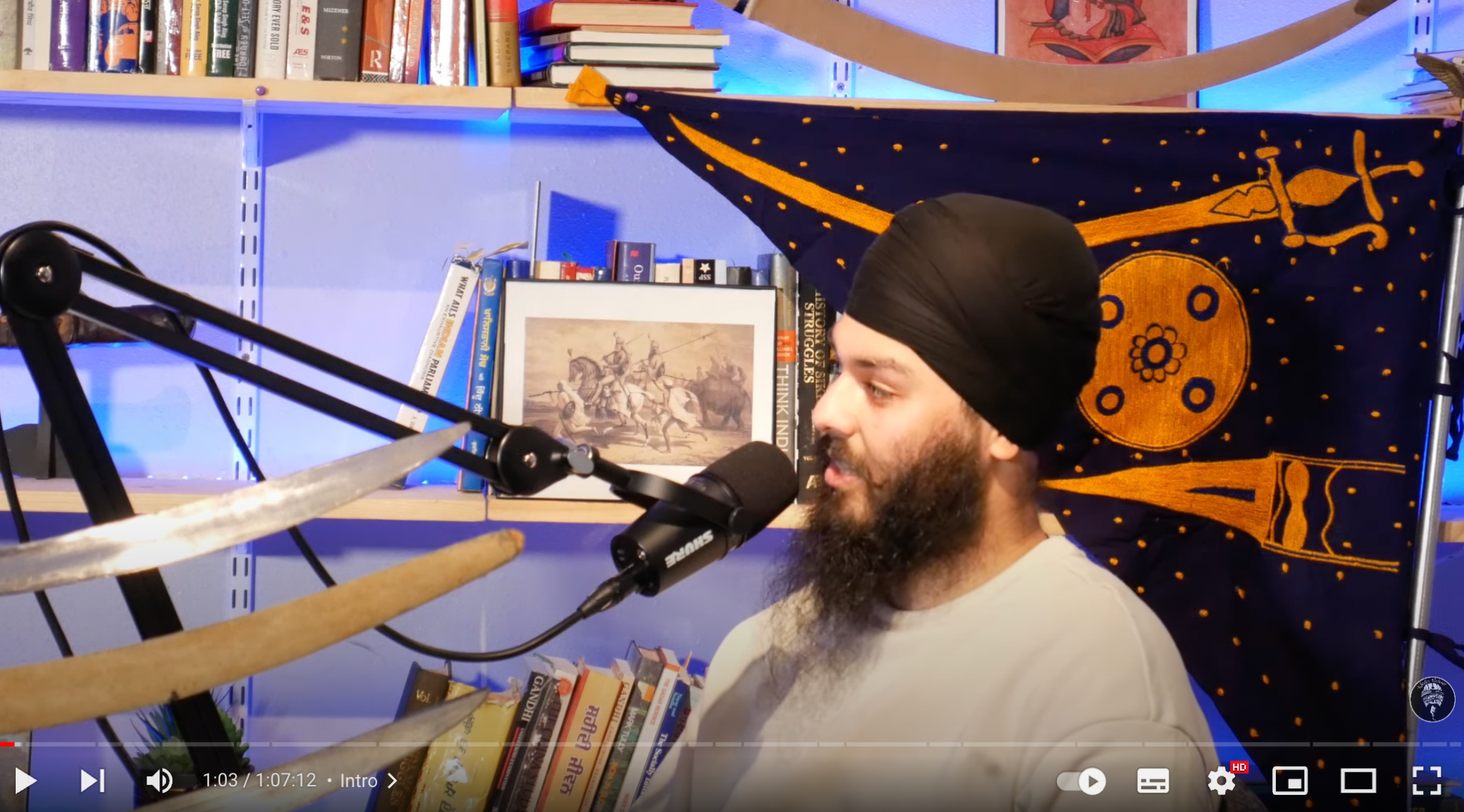
Most of the successful engaging podcasts I’ve studied use a three-camera setup. Something so simple can actually enhance the total engagement of the podcast.
A typical 3 camera layout includes:
- Wide shot – This is the base shot, it captures everything, including the host and the guest or guests.
- Tight/close-up of the host – This shot involves a close up to the host of the show, typically during moments where the host (me) speaks.
- Tight/close-up of the guest(s) – Just like with the host, it allows for more emotionally invested authenticity and also appeals more to the audience rather than the same angle for the entirety of the episode.
Using a 3-camera setup and switching between angles live using vision mixing makes each episode seem much more authentic and professional. It prevents the video from becoming static and keeps the engagement high. Similar to how movies or tv shows don’t simply use one angle for their scenes, they keep transitioning within the same scene.
Shot Examples:
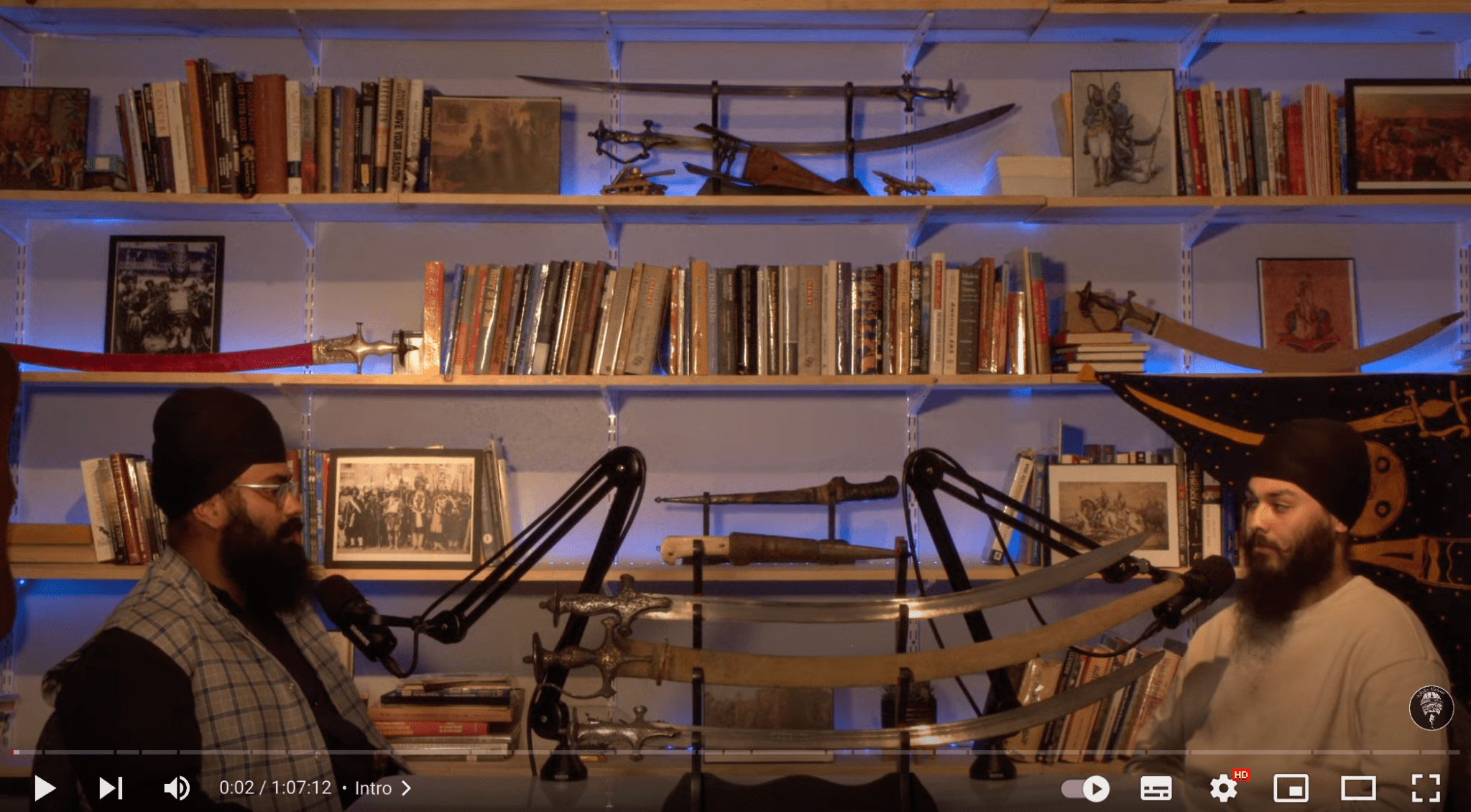
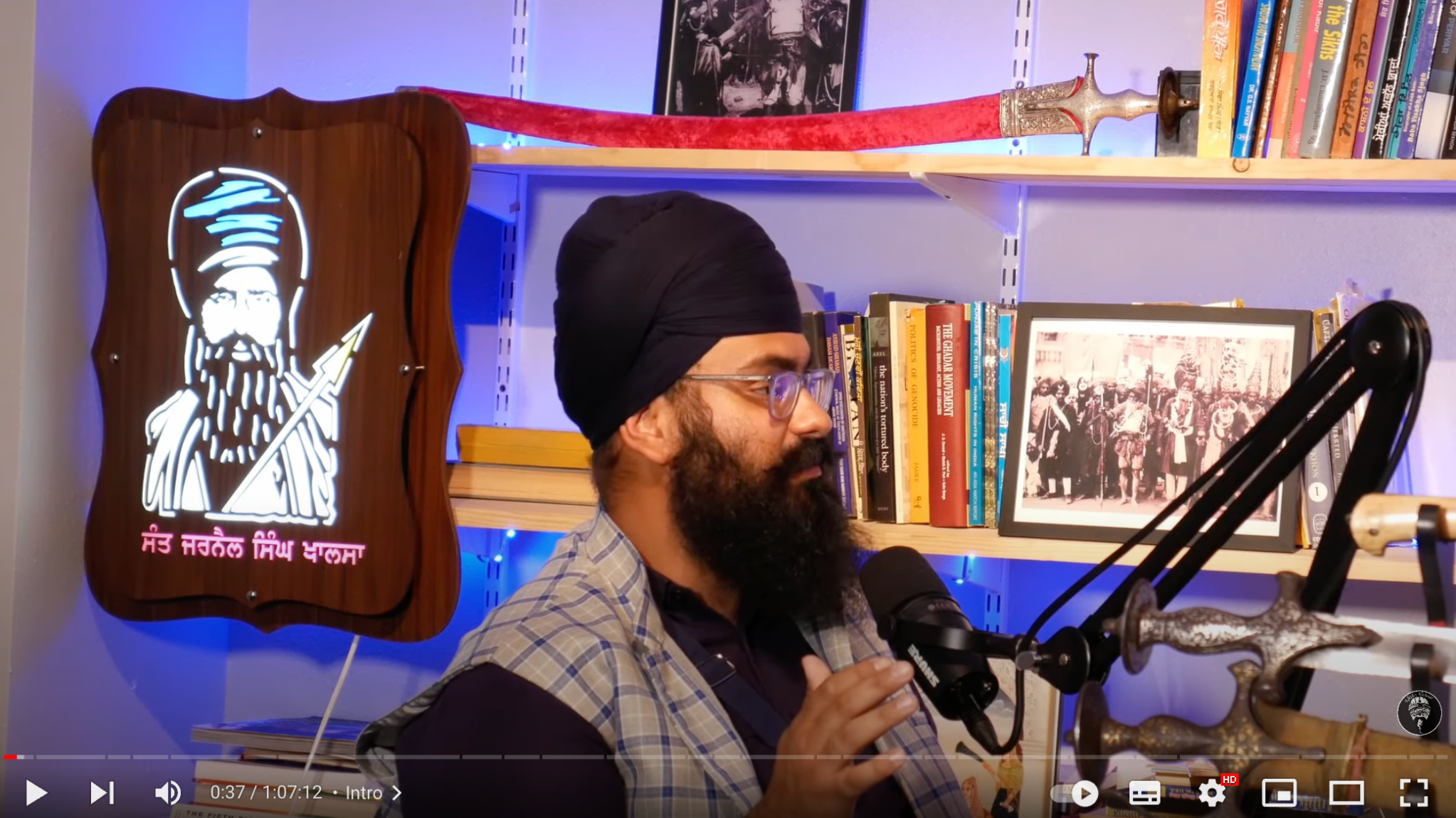
Shot example 1: Close up of Host Shot example 2: Wide shot covering both speakers Shot example 2: Close up of the guest
Story research
Facts about the story I will be telling:
The individuals that I will be bringing on the podcast will be providing facts regarding what will be addressed in the podcast. All individuals that will be invited onto the podcasts will be Gursikhs and will know what they will be talking about.
I will also be creating carousel posts that contains information which will be uploaded to instagram.
Where I will get my information & How I got my information:
Regarding to how I will get the topics that I want to discuss on the podcast, I will gather them from the primary research I will gather.
I will be looking at old historical accounts and narratives of the british written during the 18th century – all linked in the bibliography.
For carousel posts I will also look at old writings and accounts of the british when they were trying to over rule Panjab.
Podcast Guests
Sikhfinity Research: Who is he?
Artists who not only produce music but also develop distinctive brands that speak to particular cultural and thematic identities are becoming more and more prevalent in today’s music scene.
Working with Sikhfinity on a podcast offers a unique and priceless chance to delve into the depths of a largely mysterious artist.
He is not very known, despite his engagement with traditional Sikh forms like Dhadi Vaaran, Kavishari, and Kathas which has begun to gain popularity among specialised online communities. Apart from his name, Sukhdeep Singh, and a limited online presence, mostly on Instagram, Sikhfinity has maintained his anonymity. This mystery on his life and his identity is exactly what will draw a lot of his fans to watch the episode.
Additionally, in an era where digital branding often overshadows artistic integrity, Sikhfinity stands out as someone who lets the art speak before the persona. This approach in itself is worthy of conversation. A podcast gives him a space to articulate his intentions, the reasoning behind his creative choices, and his vision for Sikh-centered content in the modern world.
Because there is virtually no long-form content about him, a podcast episode would be not just timely, but historic—laying the groundwork for future discussions, and fan engagement.
In short, this episode would give listeners what they’ve been quietly seeking: a glimpse behind the music, and into the mind and mission of Sukhdeep Singh.
Jatinder Singh Durhailay Research: Who is he?
Jatinder Singh Durhailay, renowned for his paintings, music, and ventures into the world of fashion and modelling, was born in London in 1988.
His Artistic Style:
- Durhailay is known for his intricate and observant paintings and drawings executed in the style of Indian Mughal miniature painting.
- His work blends traditional techniques with contemporary themes, often portraying the Sikh community and culture with humour, heroism, and poignancy.
- His subjects range from environmentalism to figures like Bruce Lee, moving between historical artistic tropes and the complexities of the present day.
- He has a particular interest in using naturally derived pigments in his art.
- Durhailay’s artworks are part of significant private collections, including those of Davinder Toor and Sir Richard Heaton, as well as museums such as the Montreal Museum of Fine Arts in Canada and the Museum of Art and Photography in Bangalore, India.
- He has exhibited his work internationally in galleries in London, Tokyo, and Delhi.
Musical Talents:
- Durhailay is a trained musician in Indian classical music.
- He performs and practices Kirtan (Sikh devotional singing).
- He plays rare classical instruments such as the Dilruba and Taus. The Dilruba, meaning “heart stealer,” was historically popular among Sikh warriors and the Maharajas of Punjab.
- He is part of a musical duo Petit Oiseau and has performed at prestigious venues like the Victoria & Albert Museum and the National Gallery in London.
- His musical compositions often include Raags, the traditional melodic framework of Indian classical music. You can find his instrumental piece “Kalyan Raag Instrumental” on SoundCloud.
Fashion and Modelling:
- Jatinder Singh Durhailay has also made a notable presence in the fashion world as a model.
- He notably modelled for Louis Vuitton for the Financial Times Winter 2014 campaign. This made him the first turbaned Sikh to model for the brand. He was featured on the front page of the Financial Times wearing a turban and Louis Vuitton jackets.
- He has also modelled for Adidas and GQ India.
- His unique style, often featuring colourful turbans and a blend of traditional and contemporary elements, has made him a sought-after figure in fashion.
- He has also modelled for Levi’s and Topman.
- GQ India featured him modelling Ozwald Boateng collections in their 2012 annual edition.
Jatinder Singh Durhailay’s diverse talents and unique perspective have established him as a significant figure in contemporary art, music, and fashion, celebrated for his ability to bridge tradition with modernity.

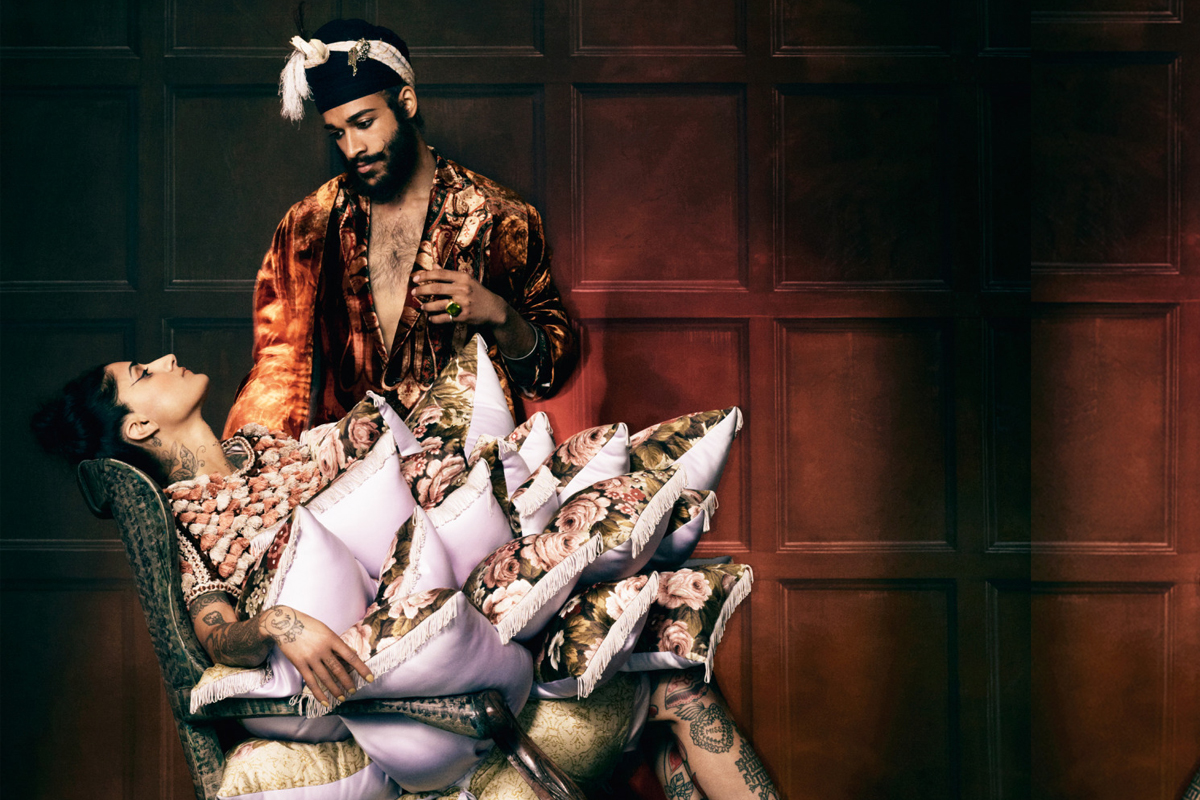

Above are photographs from the time he modelled for Louis Vuitton for the Financial Times Winter 2014 campaign
His art form:
Part of my research for my guest Jatinder Singh Durhailay, consists of looking at various things, one being Miniature Art.
What are Miniature paintings?
Miniature paintings are small-format, highly detailed illustrations that flourished under the Mughal Empire in South Asia (1526–1857). These works were not standalone paintings; they were integral to manuscripts, albums, and historical texts, blending literary richness. Their intricate execution, vibrant colours, and eclectic styles made them one of the most sophisticated forms of pre-modern Indian art.
What are Miniature paintings?
Miniature paintings are small-format, highly detailed illustrations that flourished under the Mughal Empire in South Asia (1526–1857). These works were not standalone paintings; they were integral to manuscripts, albums, and historical texts, blending literary richness with visual splendor. Their intricate execution, vibrant colours, and eclectic styles made them one of the most sophisticated forms of pre-modern Indian art.
Historical Origins and Development
- The art form evolved from Persian miniature painting, especially from the Herat and Shiraz schools of the Timurid dynasty.
- When Mughal founder Babur invaded India, he brought Persianate culture with him, though he didn’t emphasize painting.
- The art flourished under his son, Humayun, who during his exile in Persia (1540s), developed a deep appreciation for Safavid painting.
Establishment under Emperor Akbar (1556–1605)
- Akbar created the first royal atelier (kitabkhana), employing over 100 artists.
- He initiated large-scale illustrated projects such as the Hamzanama, employing both Persian masters (Mir Sayyid Ali, Abdus Samad) and local Indian painters.
- Themes expanded to include Indian epics, folk stories, portraits, and court scenes.
- This era marked the Indo-Persian hybridization of the style.
Evolution
Jahangir (1605–1627): The Aestheticist
- Jahangir was deeply interested in naturalism, portraiture, and scientific realism.
- He commissioned botanical and zoological studies (Ustad Mansur’s painting of the dodo).
- Fascinated with European prints and Renaissance-style realism, which influenced depth, perspective, and shading.
Shah Jahan (1628–1658): Refinement and Splendor
- Known for architectural symmetry – Taj Mahal, his miniatures reflected similar precision and grandeur.
- Paintings often featured courtly life, processions, and refined aesthetics with symmetrical compositions, elaborate textiles, and jewelry details.
- This was the zenith of formal elegance in Mughal art.
Aurangzeb (1658–1707) and After
- Due to Aurangzeb’s orthodox religious stance, imperial patronage declined.
- Miniature art continued in provincial courts like Awadh, Hyderabad, and Murshidabad, often blending local traditions.
- Decline in originality but still carried legacy in Company Paintings and Rajput miniatures.
Techniques and Materials
- Typical size: 4–12 inches wide.
- Used for books, albums and royal chronicles.
Materials Used
Paper: Handmade from rice, hemp, or cotton pulp.
Pigments: Natural and mineral-based:
- Lapis lazuli for blue
- Cinnabar for red
- Malachite for green
- Gold leaf and shell gold for gilding
Brushes: Made of squirrel hair, sometimes just a few strands for micro-detailing.
Artistic Techniques
Preparation:
- Surface was polished using agate stones.
- Outlines made with charcoal or ink.
Painting Process:
- Applied in layers, from base colors to fine details.
- Used wash technique for skin tones.
- Final touches included burnishing, gilding, and calligraphy.
Perspective and Composition:
- Early works: flat, vertical perspective
- Later works: adopted European-style linear perspective and chiaroscuro (light/dark contrast)
- Use of nested framing and architectural elements to guide viewer focus
It’s important for me to look into the art for a deep understanding so I can see Jatinder’s influence and pick out how his art has his own custom elements.
Deeper analysis into the art means, I can conduct a deeper analysis of his art prior to the podcast recording.
Iconography and Subject Matter
Political and Courtly Narratives
- Darbars, battles, hunting expeditions, royal processions.
- Royal self-fashioning—emperor as a divine ruler or just sovereign.
- Example: Akbar receiving ambassadors in the Akbarnama.
Nature and Science
- Under Jahangir, detailed studies of flora/fauna.
- Inspired by both Islamic tradition of classification and European scientific illustrations.
- Example: Ustad Mansur’s watercolours of birds, including now-extinct species.
Portraiture
- One of the most sophisticated genres.
- Characterised by:
- Profile view
- Detailed facial features and attire
- Incorporation of symbolic elements: Example, halo for emperors
Symbol of Empire
- Visual representation of the emperor’s control, sophistication, and cosmic order.
- Commissioned to record events and legitimize rule.
- Reflected religious tolerance: inclusion of Hindu, Jain, Sufi, and even Christian motifs.
Now looking at visual examples that I can see I looked into famous peices and where they may be located if they still exist.
Key Examples and Collections
Notable Works
- Hamzanama (1557–1577) – Largest Mughal illustrated manuscript (1,400 folios)
- Akbarnama – Royal biography of Akbar
- Jahangirnama – Illustrated memoirs of Jahangir
- Shah Jahan Album – Portraits and calligraphy collected for the emperor
Major Collections
- British Library, London
- Victoria & Albert Museum, London
- National Museum, New Delhi
- The Metropolitan Museum of Art, New York
Out of these, I have visited the Victoria Albert museum.
During my visit I also attended a special exhibition ‘The Great Mughals’, which mainly highlighted Mughal armoury, Art and fine craftsmanship.
Below are images from my visit:
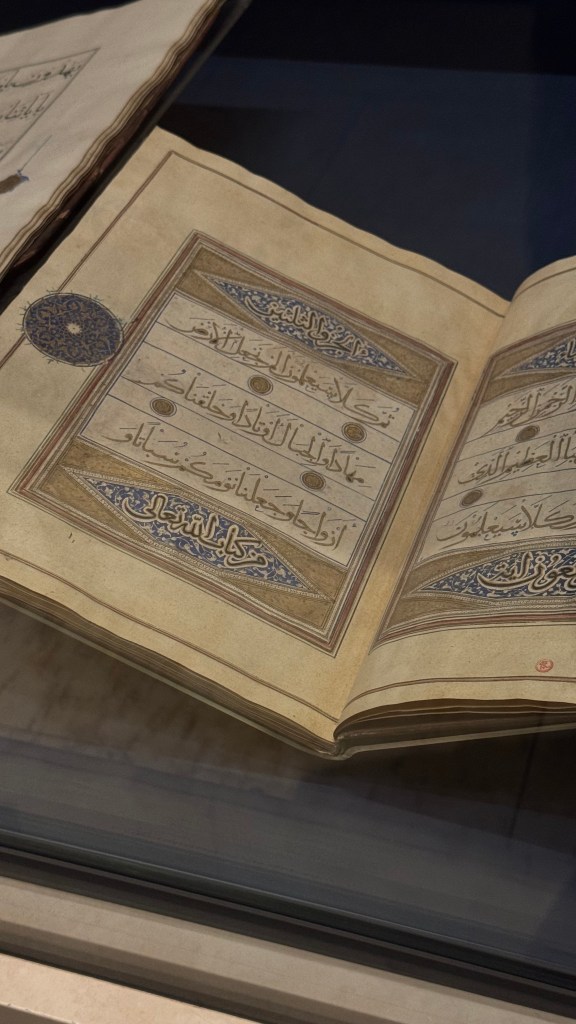
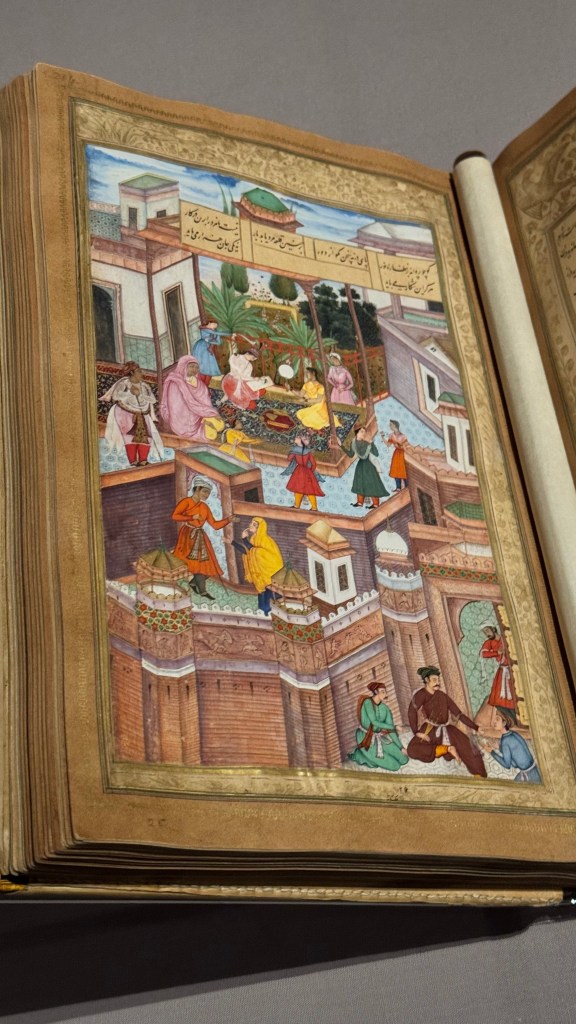


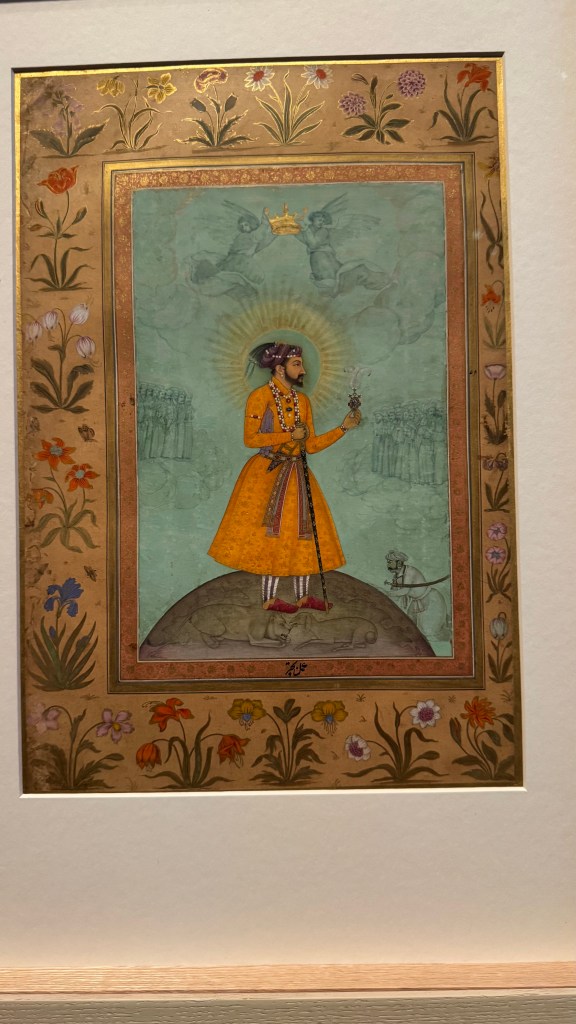

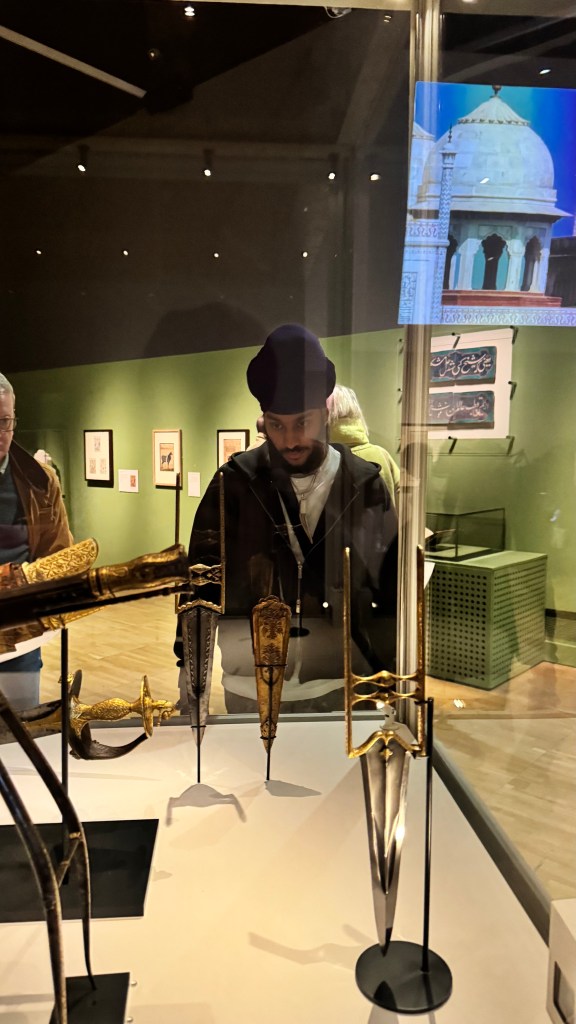
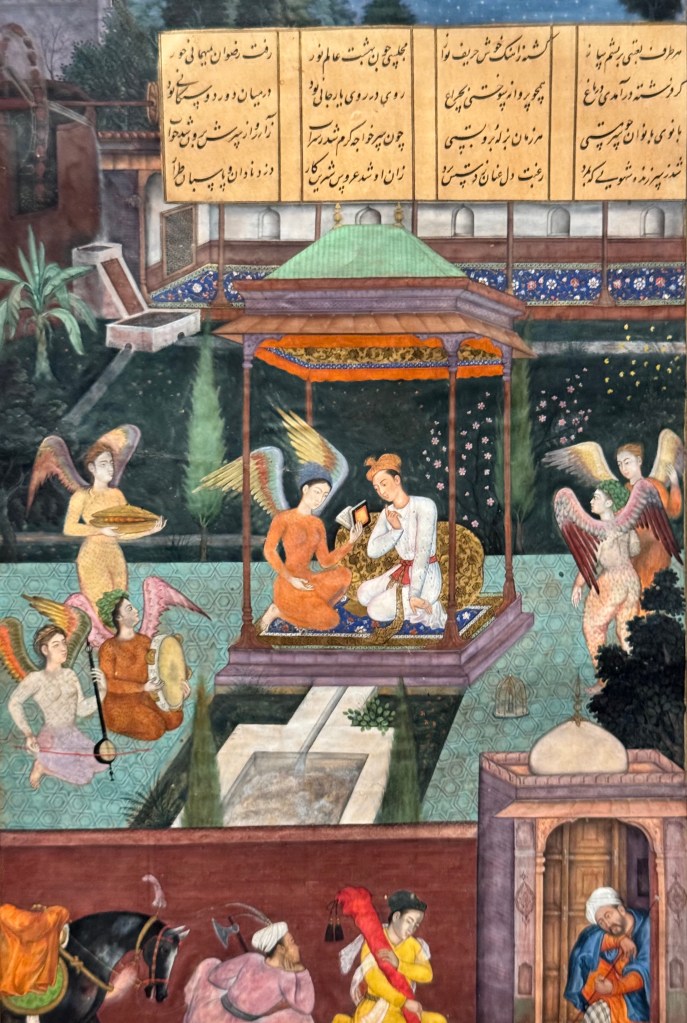
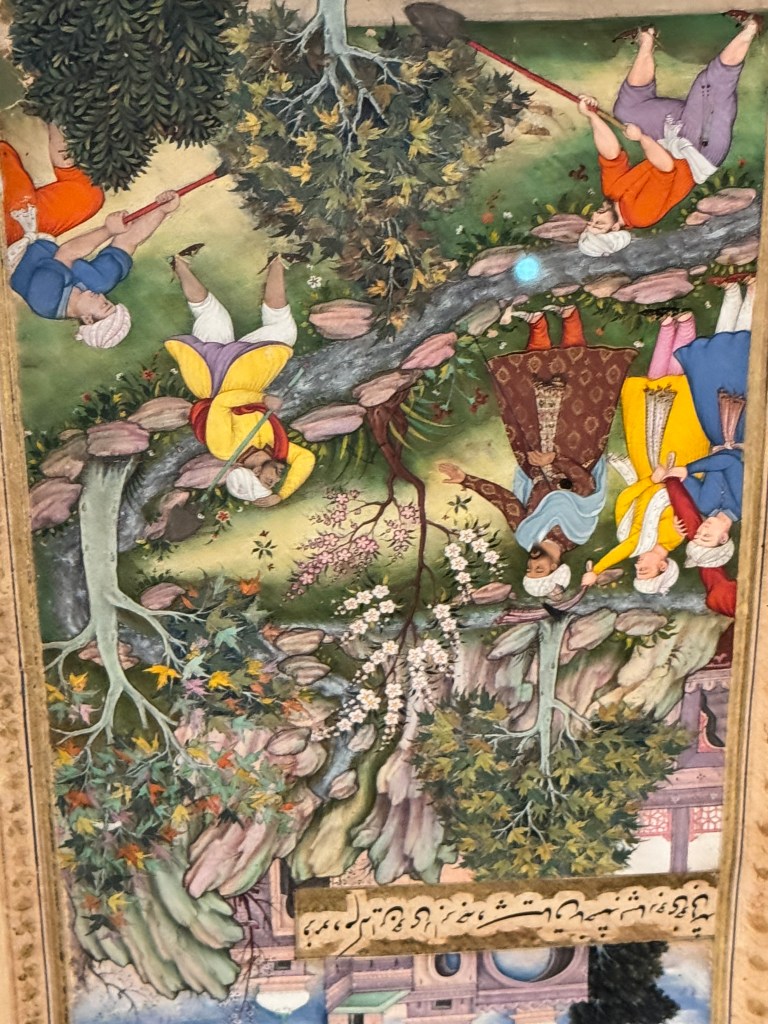
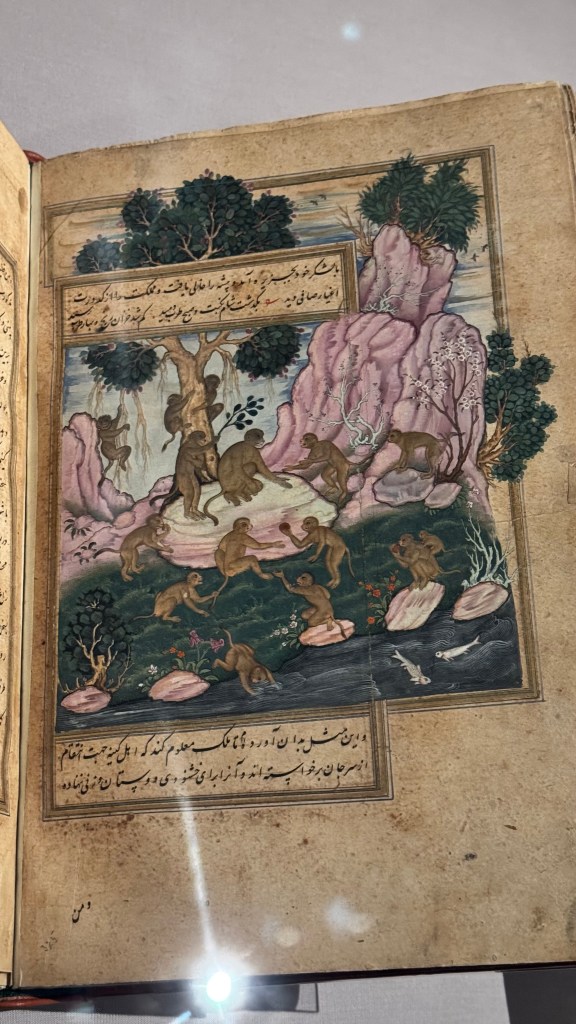
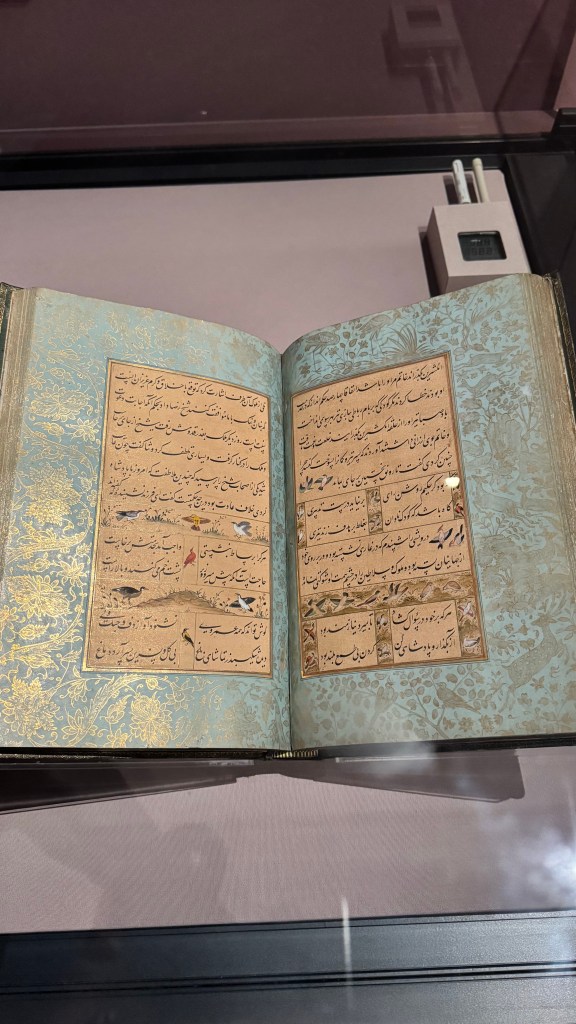

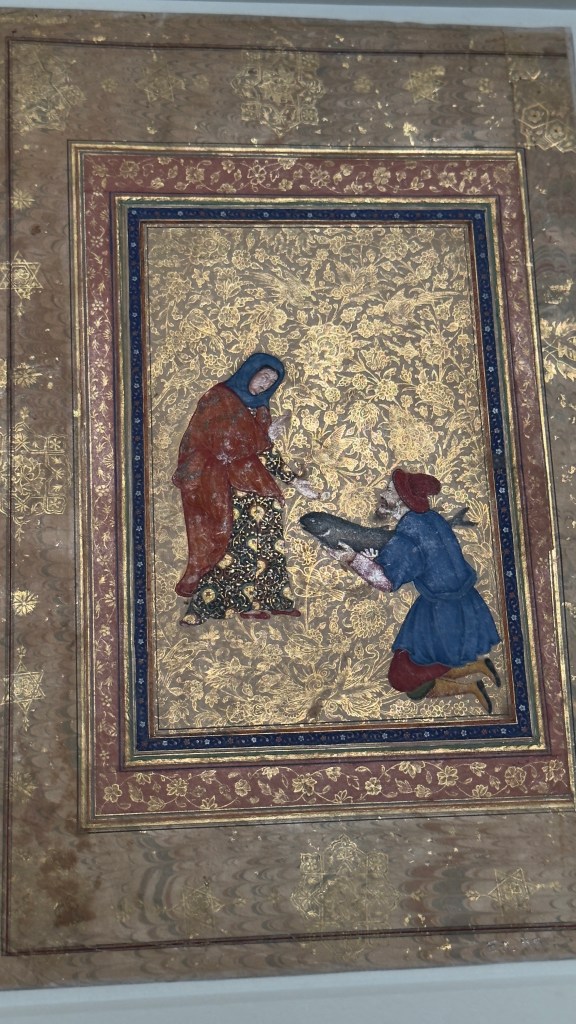
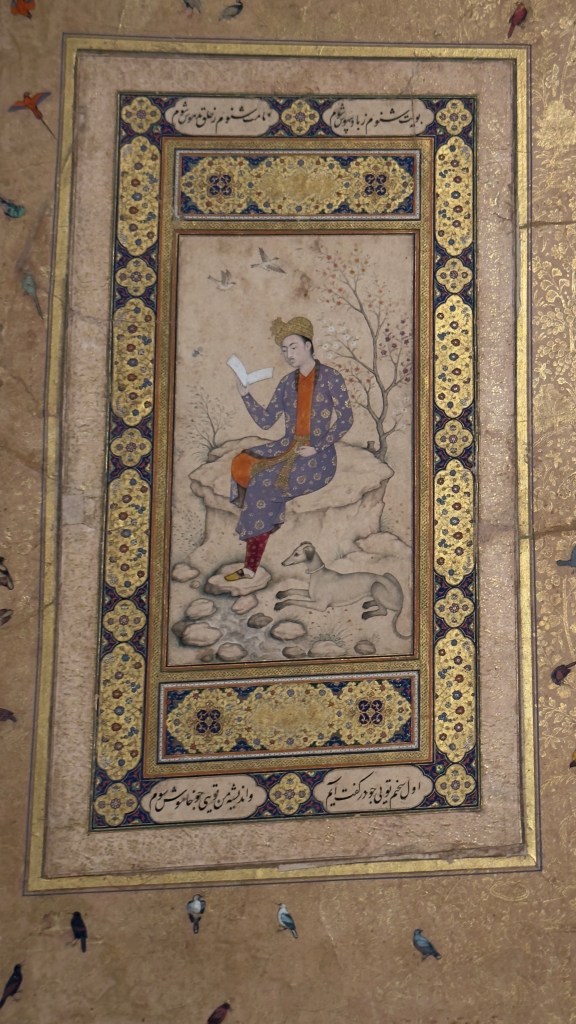
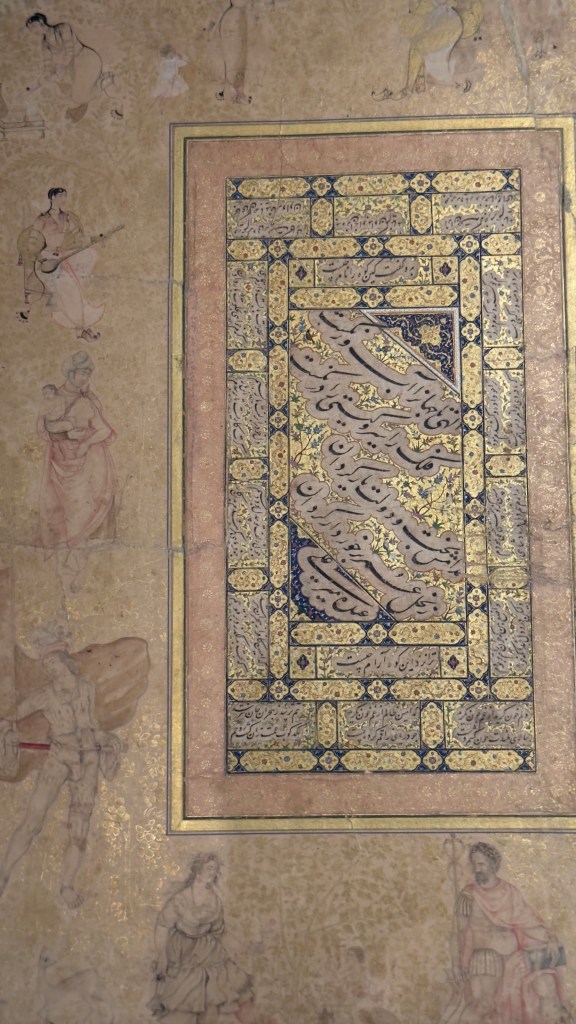
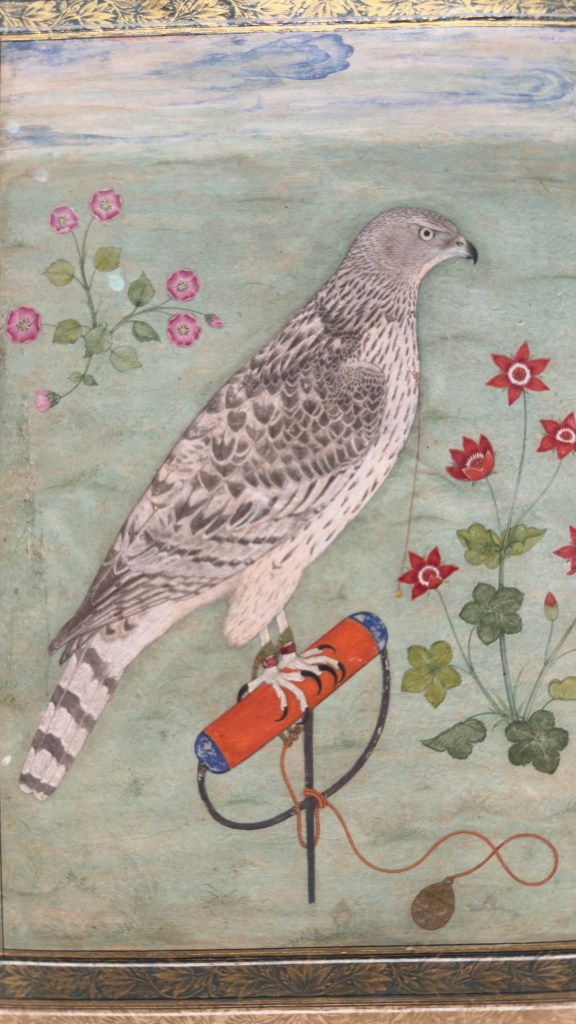


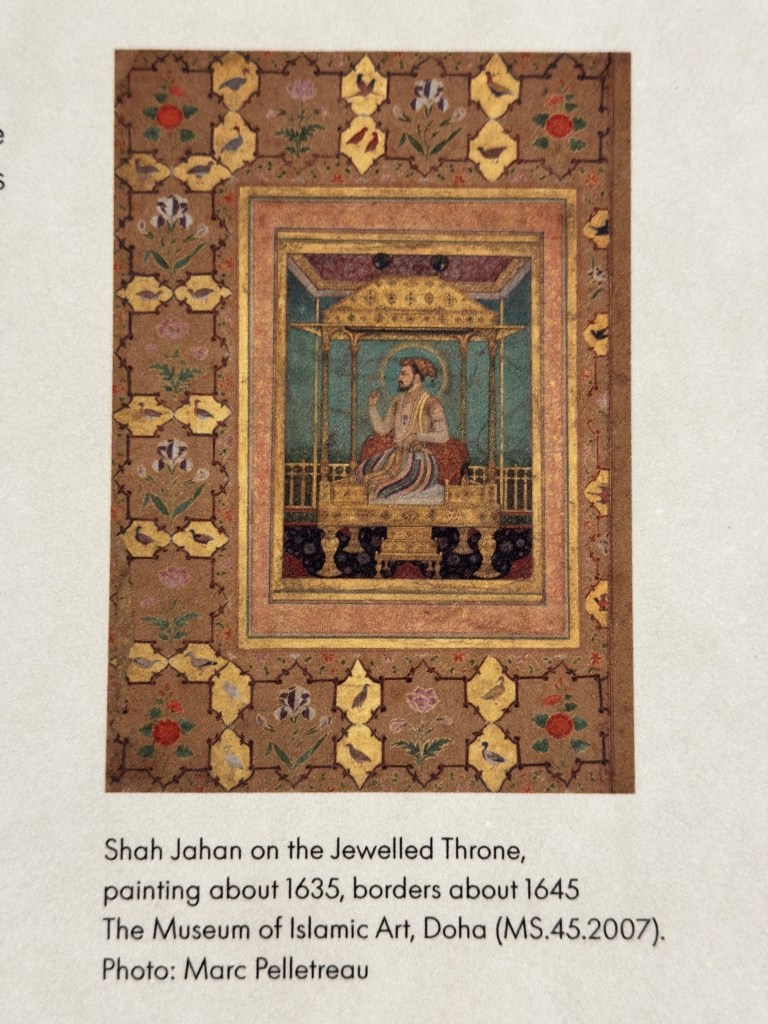

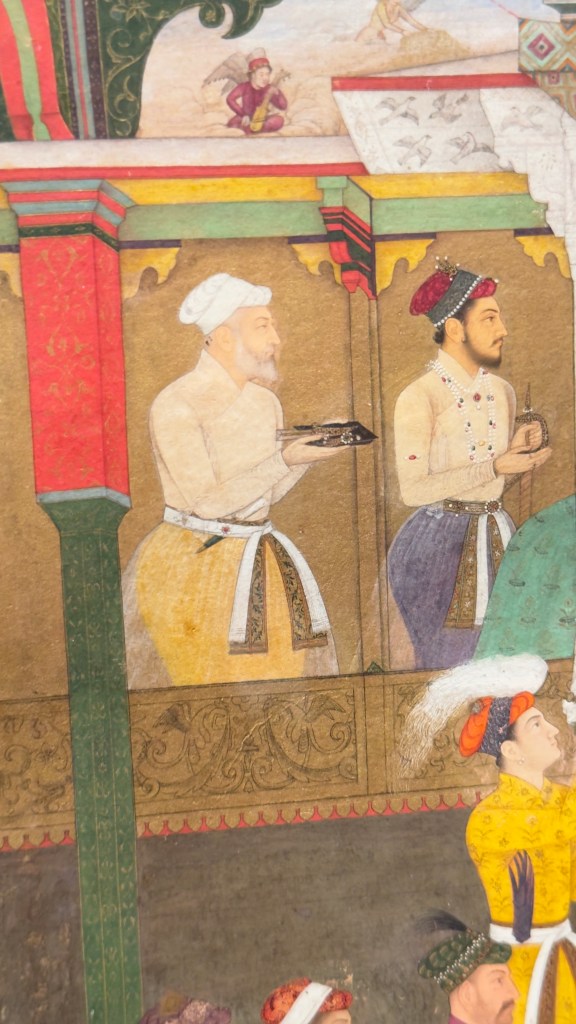
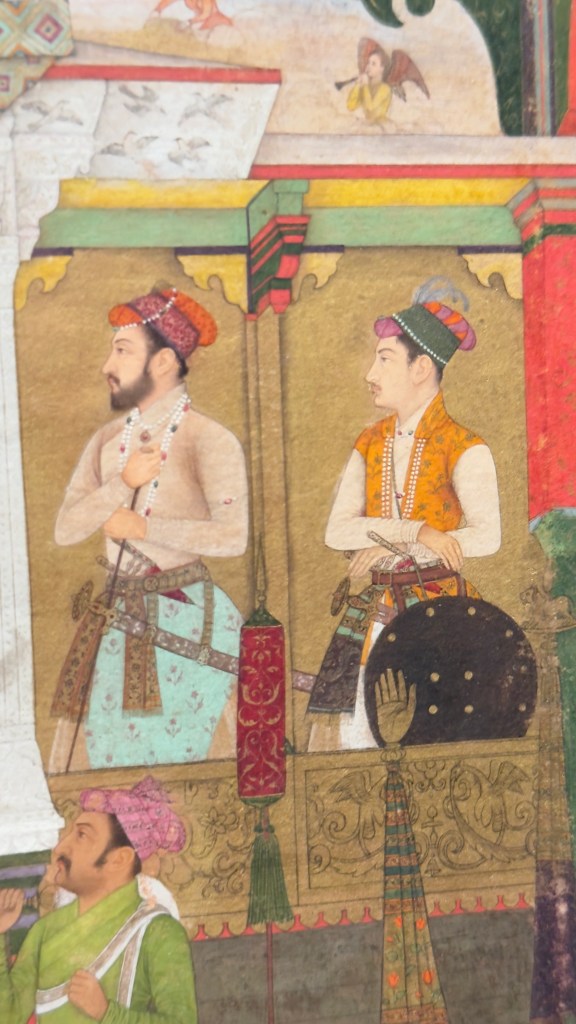
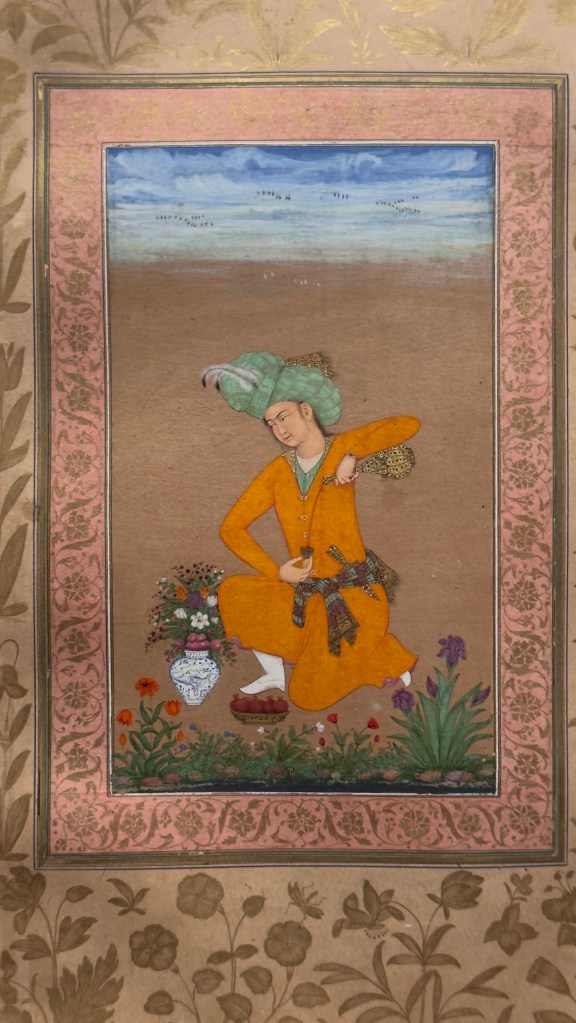
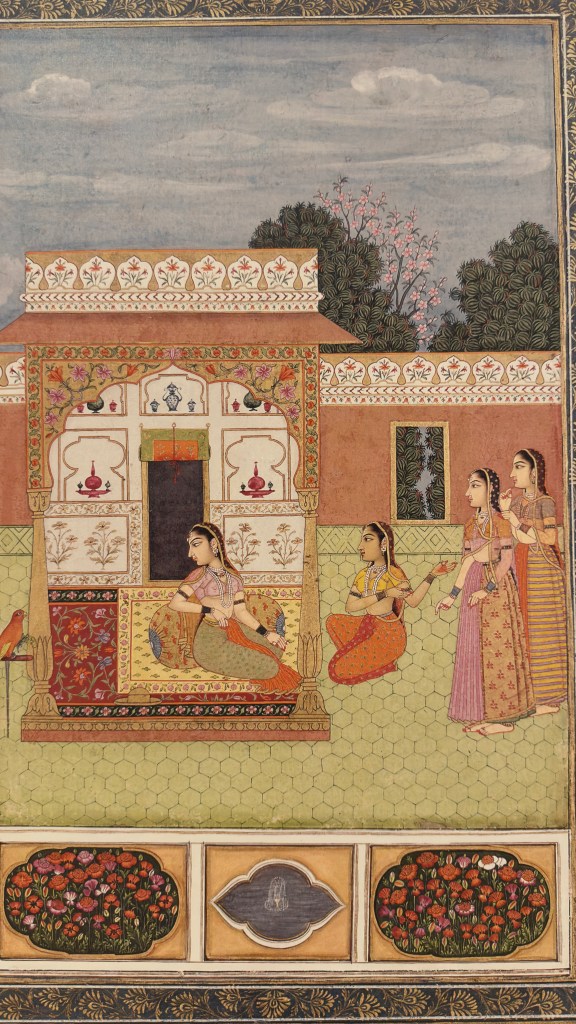
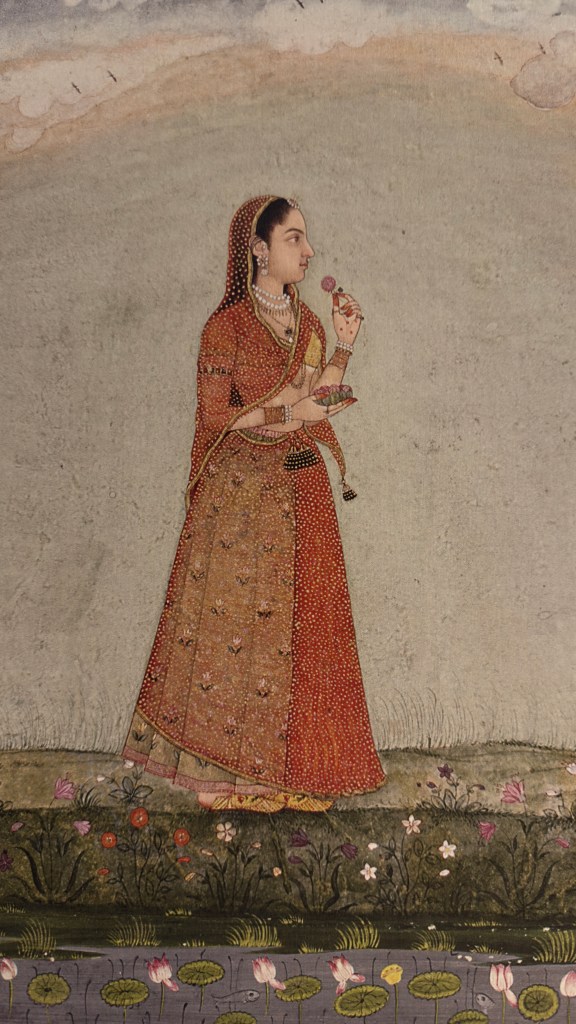


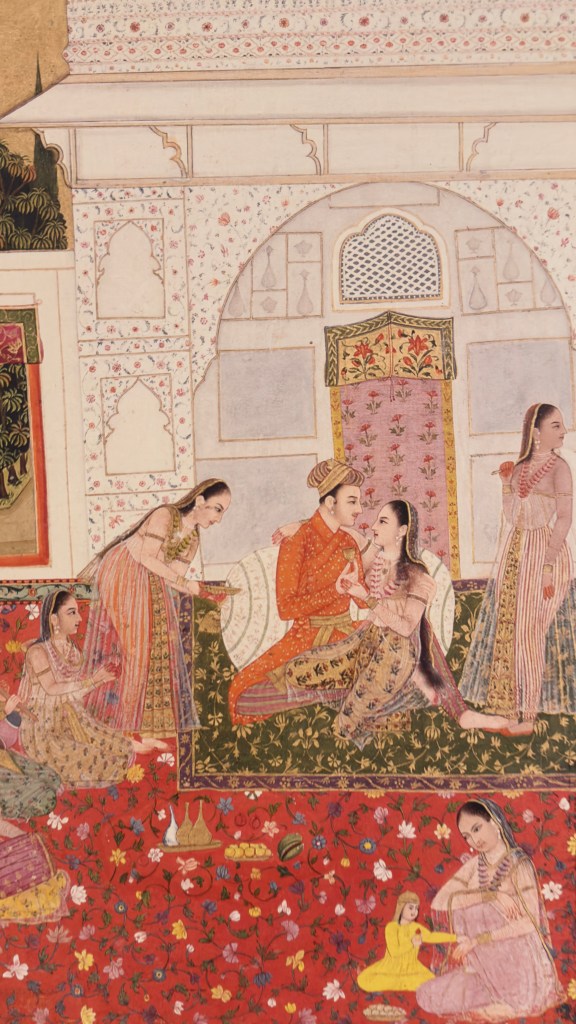

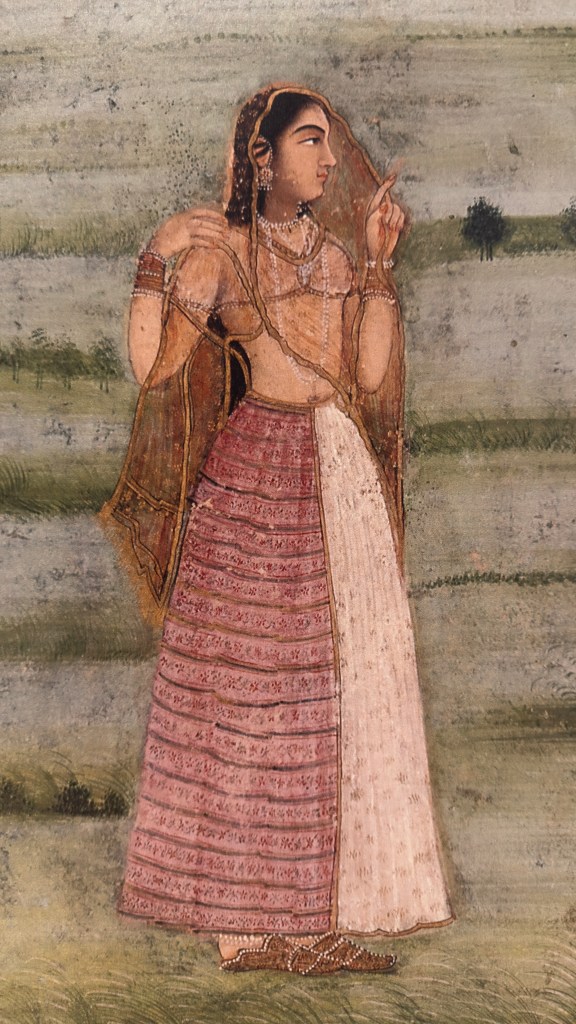
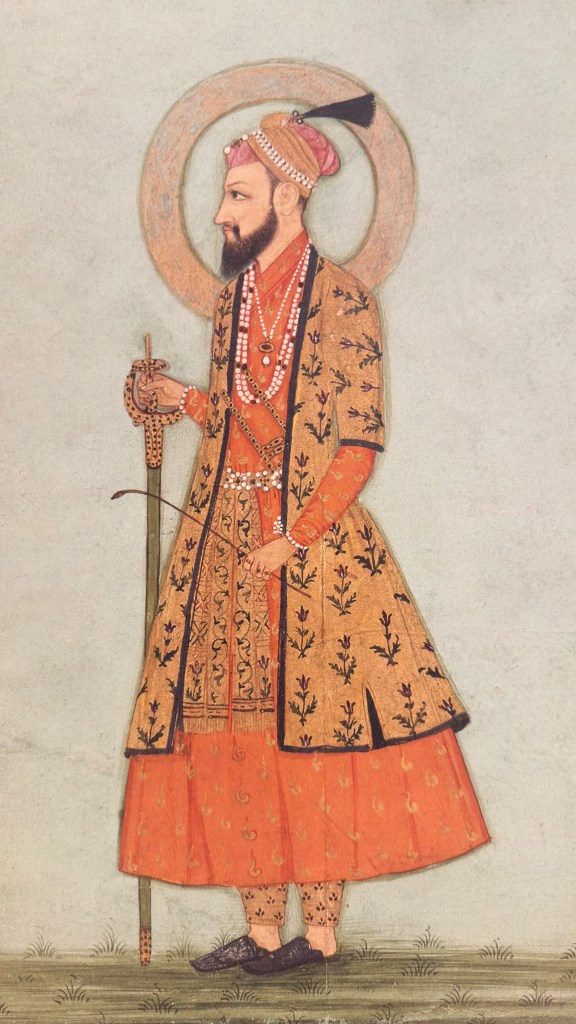
My visit to the V&A’s Great Mughal exhibition vividly enhanced my understanding of Mughal miniature paintings and imperial artistry. Seeing the originals firsthand allowed me to truly appreciate their astonishing detail and rich colour.
The exhibition clearly underscored the unique blend of Persian, Indian, and European styles that define these works.
Displayed alongside other courtly arts, the miniatures were effectively contextualised within the opulence of Mughal life and imperial patronage.
Furthermore, gaining insights into the collaborative imperial workshops clarified for me the sophisticated, cross-cultural influences that shaped these exquisite artworks.
Other sources for research:
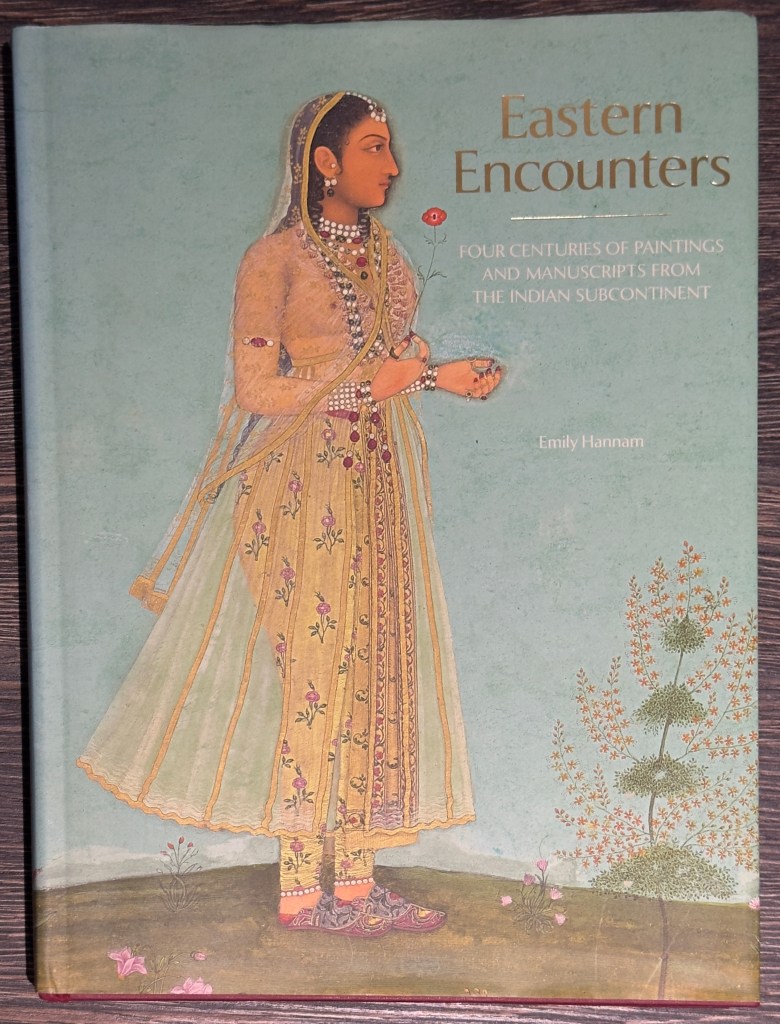
Digital Books:
Painters at the Sikh Court: A Study Based on Twenty Documents
Book by B. N. Goswamy
A Jainesque Sultanate Shahnama and the context of pre-Mughal painting in India
Book by B.N. Goswamy
Pahari paintings from the Eva and Konrad Seitz
Sikh Art from the Kapnay Collection
Stylistic research:
Examples of the style I am trying to emulate and how the audience consumes it:
Regarding to the style that I am trying to emulate, I do not have a specific style to emulate as my target audience does not have many Sikh related podcasts, for this reason, I am open to explore my own individual style.
https://www.youtube.com/embed/0uz4cFV__cA?feature=oembedThe podcast I gained inspiration from for both topics to studio layout
Through my research on Social media and feedback received regarding my personal content, which was described as ” Your work is really aesthetic and clean”, from this I can interoperate that my current style in how I organise and post things will be successful.
To uphold the aesthetics, I will be using the podcast suite as it has a very neutral and aesthetic set, within the studio there are also background lighting that can be changed in between many colours. I will be using this feature to replicate the coloured linked to the Sikh faith, to replicate an aesthetics with colours that are co-ordinated with the colours used/ worn in the Sikh faith.
Textual Analysis of existing podcasts:

Podcast: The Khuley Vichaar
The Critical Thinkers / Rebels
Overlap with: Diaspora Youth, Cultural Creatives
Traits: Question tradition, anti-establishment, politically aware
Why They Listen: For open discussion on taboo topics (mental health, caste, religion, gender, etc.)
Diaspora Youth
- Traits: Grew up or live outside Punjab; bilingual; juggling dual identities
- Why They Listen: To reconnect with Punjabi roots through a progressive lens; feel seen/heard in their hybrid experience
- Overlap with: Critical Thinkers, Meme-Culture Fans
Cultural Creatives
- Traits: Artists, poets, musicians, designers, indie filmmakers
- Why They Listen: Appreciate bold, unfiltered conversations that reflect their work and values; drawn to creative guests
- Overlap with: Rebels, Diaspora Youth
Quiet Listeners / Lurkers
- Traits: Don’t comment or engage openly but listen regularly; may be older or conservative
- Why They Listen: Curious about what younger people are saying; some are secretly changing views
- Overlap with: Rebels (in spirit), Cultural Creatives (if older)
Podcast: Ramblings of a Sikh
The audience for Ramblings of a Sikh can be divided into a few overlapping groups:
- Young Sikhs (18–35)
- International and local (UK, Canada, US, India)
- Exploring identity, faith, and culture
- Interested in mental health, personal growth, and social issues
- Feel underrepresented in mainstream narratives
- Non-Sikhs Interested in Learning
- Curious about the Sikh faith, especially through a personal lens
- Appreciate educational, reflective content
- Seek bridges across cultures and beliefs
- South Asians Interested in Shared Experiences
- Relate to cultural pressures, family dynamics, religion vs modernity
- Looking for representation and solidarity
- Spiritual Seekers & Philosophically Inclined Listeners
- Attracted to introspective, meditative, or philosophical discussions
- Appreciate the balance between tradition and personal insight
Why Ramblings of a Sikh works as a good podcast:
- Authenticity: The tone is genuine and unfiltered, more like a friend sharing than a teacher preaching.
- Representation: Offers a rare, thoughtful Sikh voice in the podcast space.
- Relatable Themes: Touches on everyday struggles: identity, doubt, belonging – from a Sikh lens.
- Balance: Combines storytelling, cultural critique, spirituality, and vulnerability.
- Educational Without Being Didactic: Non-Sikhs can follow along without needing prior knowledge.
- Safe Space Feel: Listeners feel seen, not judged. It’s introspective and invites reflection.
Ramblings of a Sikh Swot analysis:

Audience research – Who are the audience? Why what I do works for them (Including a composite audience member).
Who is my audience – Well my audience is those within the Sikh community that wish to learn more about the faith and certain topics, traditions and myths that they are unsure of. Keeping this in mind I, also have to be mindful about those that may not no much about the topics and diving into some of the complex can be confusing to understand. Which is the reason why I will have the podcast discussions set up in a layout and process that will enable me to haven broken down and basic topic discussions and then gradually build up the discussions complexity.
Psychographic Character analysis
Male Female


SWOT Analysis:

Strengths:
- Editing skills
- Social media recognition
- Social Media managing and promoting
- Aesthetics
Weaknesses:
- On camera confidence
- have a lot of work to carry out by myself, I will not be able to procrastinate
- Don’t have much knowledge about audio
Opportunities:
- Already have an audience
- Have a social media page with 10k followers on Instagram to collaborate with
- Have a YouTube channel with the subscribers being the main target audience
Threats:
- Guests having no availability to come onto the podcast
- Insignificant amount of time due to any delays
Primary Research
In my role as the social media manager for Khalsa Panth UK, I recently executed a comprehensive poll on the organisation’s official Instagram account. The survey elicited a substantial volume of responses from our engaged audience, providing me with a rich dataset to conduct a detailed analysis of the prevailing social media demographics and analytics. This in-depth examination not only offered valuable insights into the characteristics and preferences of our online community but also facilitated a nuanced understanding of the trends and patterns shaping our digital presence.
Bellow is the data broken down:
Audience that would like discussion/podcast style content – 81%
Age Group: 15-20 & 21- 30 both with equal engagement percentage at 37%.
Platform: Primarily on Instagram, YouTube, and TikTok.
Content Strategy: Short-form content on Instagram, TikTok, and YouTube shorts to attract attention and redirect viewers to full episodes on YouTube.
Education/Career Stage: Still in education or early stages of work career.
Social Media Usage: Frequent users of social media.
Level in Sikhi: Has some knowledge of Sikhi and is eager to learn more.
Gender: Mainly male (80%), but can have a female guest to attract more female audience members.
Focus groups are best and they
are best when testing an actual piece of content.


Sources for research
Sikh_Art_from_the_Kapany_Collection_full (1).pdf
Glimpses of Sikhism – Google Books
Pages 145 – written by Indian Army Major talks about Akali Ji at Damdama Sahib, battles of Multan, Kashmir and Peshawar
The Religion of the Sikhs – Google Books
Nihangs tried to retake Akal Takht in 1848, British took over in 1849
The Calcutta Review – Google Books
Note in the Calcutta review that says Akali Phoola Singh offered to support the British
John Laird Mair Lawrence, a viceroy of India, by William St. Clair – Google Books
Viceroy of India writes of Akali Ji’s Shaheedi
The Asiatic Journal and Monthly Miscellany – Google Books
Ex Raja of Nagpur ‘Appah Saheb’ takes shelter with Akali Phoola Singh
A History of the Reigning Family of Lahore – Google Books
Good few detailed pages on Akali Phoola Singh describing him as a Robin Hood figure, shaheedi in detail and praise of the Akalis and decline after anglo sikh war
The Calcutta Christian Observer – Google Books
1832 christian describing akali’s as military spiritual dervishes
The People of India – Google Books
Detailed account of akalis – their role in gurmatta and amongst sardars. As well as their demise following the battle of sobroan
A Classified and Descriptive Catalogue of the Indian Department – Google Books
Describing the Akalis being found in Hyderabad
Travels and Adventures of the Rev. Joseph Wolff – Google Books
Nihangs insulting runjeet singh – military order of the akalis and Dasam granth
British India, Its Races and Its History Considered with Reference to the M… – Google Books
Speaks of the threat of Sikhism in that without spreading Christianity and destroying caste, that the British would be doing the work of the Sikh Gurus
The Asiatic Annual Register, Or, A View of the History of Hindustan, and of… – Google Books
1811 – Sikkhs go to Akalis to take Amrit
Thirty-five Years in the East – Google Books
Nihang who had his hand cut
The Asiatic Journal and Monthly Register for British and Foreign India, Chi… – Google Books
General octherlony nearly killed by an akali
A Comprehensive History of India, Civil, Military, and Social, from the Fir… – Google Books
Shows Nihang singh dastar amongst captures canons of anglo sikh war
The United Service Magazine – Google Books
Account of shaheedi degh used in battle referncing battle of chillianwallah
A Year in India – Google Books
Visit to Amritsar
A History of the Sikhs, from the Origin of the Nation to the Battles of the… – Google Books
Akali Sadhu Singh Shaheedi
Asiatic Journal and Monthly Miscellany – Google Books
Octherlony nearly assassinated by an Akali
The rajas of the Punjab, the history of the principal states in the Punjab … – Google Books
Page 134 Akali Phula Singh destroys camp of Whyte have earlier attacked Ludhiana
Hindu Tribes and Castes – Google Books
The Akali Sikhs and Jhatka
Ars Quatuor Coronatorum – Google Books
Nihangs and nirmalas late 1800s
The Second Anglo-Sikh War – Google Books
1848 – 1849 Second Anglo Sikh wall after which Punjab was annexed, Daleep Singh brough to England
Ballou’s Pictorial – Google Books – Sikh Chieftan, Indian Mutiny views of Nihang iSinghschange
Sikh initiation akali Ars Quatuor Coronatorum – Google Books
ca;cutta review – Google Books talks about the practise of Bibek
The Illustrated London News – Google Books baba hanuman singh from newspaper
BLACKWOOD’S LADY’S MAGAZINE – Google Books – journal of the Indian campaign talks about the Nihangs presence at Sobroan maddening the Sikhs
History of the Punjab, and of the Rise, Progress & Present Condition of the… – Google Books– how the power of akalis declined after gurmatta
http://www.gurmatacademy.org/reference/martyrs/sham-singh-attariwaala/


 Balraj Singh 2025 Year 13 FMP